
Experienced Divorce Attorney in Rochester, NY
If you are considering ending your marriage, working with a Rochester divorce lawyer can help you understand whether or not you meet the eligibility requirements in New York. Before any divorce case moves forward, two vital requirements have to be met: residency and legally recognized grounds.
You might assume that you can handle your divorce case on your own, saving money on legal fees. Unfortunately, divorce is likely to pose significant financial hurdles for the next several years of your life, and the thought of taking on additional economic strain in the form of attorney’s fees from a Rochester family lawyer can be difficult to justify.
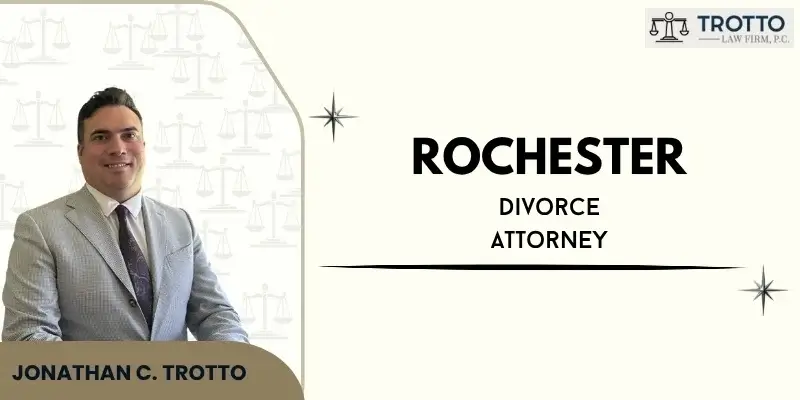
However, it is vital to understand that you stand to lose more than you could gain by foregoing legal counsel. Divorce proceedings are more complex than many people realize, and it is crucial to enter your divorce case armed with legal counsel you can trust.
Working with an experienced Rochester, NY, divorce lawyer can lead to a more positive outcome than you could have managed alone. You can also approach the situation with peace of mind and greater confidence when you have an experienced legal team handling your divorce proceedings on your behalf.
In addition, you can rely on the team at the Trotto Law Firm, P.C., to provide ongoing support through every stage of your case, ultimately helping you reach the most favorable divorce terms possible under New York law.
We serve clients in Rochester from our local office.
To schedule a consultation, call (585) 684-7947
What Does Divorce Entail?
The divorce process is more than just ending a marriage contract. You and your spouse must also resolve property division and settle custody rights over your children if you have any. You can rely on your Rochester, NY, divorce attorney to guide you through the various stages of your divorce case, including:
- Property division: New York follows an equitable distribution law. This means property is not always divided equally, but rather based on what is fair each of the spouses. Each spouse can keep separate property, such as assets owned before marriage and inheritance. It’s possible to resolve property division through litigation or privately with collaborative law. We can help you through this process without court intervention. Marital assets may include real estate, retirement accounts, business interests, and shared investments that accumulated during the marriage. The courts consider factors such as each spouse’s income and future needs when dividing an estate.
- Spousal maintenance/alimony: If one spouse is financially dependent on the other, divorce may require a spousal support arrangement that allows the supported spouse to retain a reasonable standard of living after divorce. This spousal maintenance hinges on the difference in income between the spouses. The timeframe that payments must continue depends on how long the marriage lasted.Not every divorce results in spousal maintenance. Temporary maintenance may be ordered while the divorce is pending, which could be followed by post-divorce maintenance based on statutory guidelines. Modifications are possible if there is a substantial change in circumstances, such as job loss or medical issues.
- Child custody: Perhaps the most emotionally challenging aspect of divorce is determining custody rights over the couple’s children. The Rochester, NY, family court system must verify that the child custody determination suits the child’s best interests. The judge overseeing the case will evaluate numerous factors to decide what type of custody arrangement would be suitable for the divorcing parents’ children.
Custody matters are divided into legal and physical custody. Legal custody gives decision-making authority to one or both parents, while physical custody determines where the child lives.
In Monroe County, divorce cases are filed with the New York Supreme Court at the Hall of Justice, which is located at 99 Exchange Blvd, Rochester, NY 14614. To begin a case, you must obtain an index number from the Monroe County Clerk’s Office. The filing fee is $210, and it should be payable to the County Clerk. This number opens the official court file, where all divorce-related documents bearing original signatures are maintained.
We serve clients in Rochester from our local office.
To schedule a consultation, call (585) 684-7947
New York Residency Requirements: How They Work
New York law provides multiple ways to satisfy residency requirements. You do not have to satisfy them all, but at least one applicable option has to be met.
In New York, a divorce can be filed if:
- One of the spouses has lived in New York for at least two continuous years prior to filing
- One of the spouses has lived in New York for at least a single year, and the marriage came to be in New York, or the couple lived in New York as spouses
- Both spouses are residents of New York at the time of filing, and the grounds for divorce took place in New York
These rules for residency are jurisdictional requirements. If they are not met, the court is not able to grant a divorce.
New York Grounds for Divorce: What Are They?
Along with the residency requirements, you have to state legally recognized grounds for divorce. Most commonly, couples will file for divorce in New York as a no-fault divorce. This refers to the irretrievable breakdown of a marriage for six months at the very least. This means the relationship has been broken for six months or more. Only one of the spouses has to state this under oath.
Other fault-based grounds are still possible, and they can include:
- Inhumane or cruel treatment
- Imprisonment
- Abandonment
- Adultery
- Separation pursuant to a written agreement
Still, most divorce cases are filed under the no-fault grounds because it avoids the need to prove wrongdoing.
It is vitally important to clarify a typical misconception. Living apart for one year is not required in every divorce. A year-long separation period is only useful if seeking a separation-based ground. It is not mandatory for a conventional no-fault divorce. Knowing the difference between these distinctions is crucial before you hire a divorce lawyer to start proceedings.
Types of Divorce in New York
Outside of an annulment, which is limited to specific circumstances, there are three options for divorce in New York. These include:
- Uncontested divorce: An uncontested divorce occurs when both parties agree that the divorce should occur and amicably come to an agreement on the terms of the divorce settlement. This is often one of the quickest ways to get a divorce because there is no need for a mediation process or court intervention. It often saves money on attorney fees as well.
- Contested divorce: This is the opposite of an uncontested divorce. Both parties are unable to come to an agreement on the terms of the divorce, or one party feels that the divorce should not occur. In a contested divorce, there is much more involvement from attorneys, and it can be a much lengthier process. Both parties may attempt to go through mediation or arbitration to reach an agreement on terms, but most contested divorces go through litigation.
- Summary divorce: This is a less common form of divorce in New York that is only available to couples who have been married for less than 10 years, have no children, and have few assets or debts. This is a more informal process than other types of divorces, but it can be settled quickly.
For many divorcing couples, an uncontested divorce is preferred because it means a quick settlement with minimal attorney fees. However, some couples soon realize that what begins as an amicable process can quickly become contentious. No matter which type of divorce you are facing, having an experienced divorce attorney there to help guide you can keep you focused on a resolution rather than a dispute.
Fault vs. at-Fault Divorce
A divorce in New York can be either a fault divorce or an at-fault divorce:
- No-fault divorce: This is one of the grounds for divorce that could be either contested or uncontested. In this type of divorce, the filing party states that the marriage has irreconcilably broken down. This is the most common ground for divorce, and it does not require any evidence or proof of fault.
- Fault-based divorce: In this type of divorce, one spouse claims that the other has broken the marriage contract through some means, such as adultery, abandonment, physical or emotional cruelty, or imprisonment. This type of divorce, if proven through evidence, may have more ramifications in the divorce settlement for the at-fault party.
Grounds for an at-Fault Divorce
If you or your spouse files an at-fault divorce, the papers must list the grounds on which that filing is based. New York is one of a few states that recognize at-fault divorces and define what qualifies and what does not. Reasons for an at-fault divorce can include:
- Infidelity: This occurs when one spouse has an extramarital affair, which can impact some of the divorce settlement in terms of assets. If the at-fault spouse is proven to have spent marital funds on an extramarital affair, they could lose out on assets they would otherwise be entitled to. They could also be instructed to reimburse their spouse with those assets.
- Cruel and inhumane treatment: If one spouse behaves or treats the other spouse in a way that leaves that spouse feeling afraid, threatened, or unsafe, it could result in more than a divorce. This could be grounds for a restraining order, and it could negatively impact either party’s claim to child custody or support.
- Abandonment: If one spouse “deserts” the other or the family unit for one or more years, this could qualify as fault and potentially impact child custody or support.
- Imprisonment: Not every criminal action is intentional, but no matter how the conviction occurs, if one spouse is sent to prison for a period of three or more years, it can be grounds for divorce.
- Incurable insanity: This is a rarer type of fault-based divorce, but there may be a circumstance where one spouse is diagnosed with insanity that is believed to be incurable.
These are just a few examples of the grounds that can be considered in an at-fault divorce, though there are others. If your spouse has filed an at-fault divorce, or if you wish to file for a divorce in Rochester, NY, contact an attorney who can help you understand the process and the options available.
What Will My Divorce Look Like?
Every divorce case is different. Yours may involve:
- Reaching a private agreement regarding custody without the intervention of the court or attorneys.
- Going to court. The judge must determine what is in the children’s best interest.
- The collaborative process. Collaborative law is a great way for parties to reach an agreement on custody or other issues without the court.
- Child support: When one parent lives in the primary residence of their children in a divorce, or when parents have shared residency arrangements, child support becomes a necessity. One parent will pay basic child support to the other every month to help cover the cost of the child’s basic needs. However, the payment of basic support may vary depending on the residency schedule.Both parents are expected to contribute toward the financial cost of raising their child on a prorated basis by making payments toward the children’s health insurance, medical expenses, daycare and childcare costs, and higher education.
Your impending divorce case can require consideration of all these issues and others, depending on the unique variables at play in your case. For example, some divorce cases must address spousal abuse and other forms of domestic violence, often leading to protective orders and very carefully defined custody and visitation terms.
Important Issues in a Rochester Divorce Case
Every divorce case involves the resolution of central legal issues, such as child custody and parenting time, child support, spousal maintenance, and equitable distribution of marital property.
Why You Should Hire a Divorce Lawyer
If you are going through a divorce in Rochester, your top priority should be to hire a divorce lawyer with years of experience handling complex divorce cases at Monroe County Family Court on Exchange Blvd. New York’s divorce laws are complex, and an unfavorable outcome to your case could compromise your parental and property rights.
According to CDC data, New York’s divorce rate is about 2.4 divorces per 1,000 people. With an average home value of $508,764 and an average weekly wage of $1,833.63, financial stakes can be high in divorce. Whether you live in Park Avenue, Corn Hill, or Charlotte, having legal representation allows you to have a dedicated legal advocate by your side who cares about the outcome of your case.
The Monroe County Divorce Process: Step-by-Step
Countless people feel overwhelmed because they do not know how a divorce case functions procedurally. The following is a simplified breakdown of how a divorce case usually progresses in Monroe County Supreme Court:
- Starting the case. The divorce process starts off by filing initial divorce paperwork with the Monroe County Supreme Court and obtaining an index number. The index number formally opens the case and enables it to be proceedable in the court system. The initial motion to file can include a Summons with Notice or a Summons and Complaint.
- Service of papers. Following the filing, the divorce papers have to be properly served to the other spouse. The filing spouse cannot serve the papers personally; service has to be completed by someone who is at least 18 years old and not a party to the case. Service typically has to happen within a certain time frame post-filing, and proof of service must be filed with the court.
- Time for response. After the papers have been served, the receiving spouse has a limited time to respond. They may file an answer that disputes all or some issues, or allow the case to move forward as a default divorce if they fail to respond. A case becomes contested when the spouses disagree on one or more issues. These can include custody, child support, spousal maintenance, or property division.
- Early court milestones. When cases are contested, the filing spouse usually submits a Request for Judicial Intervention (RJI). This officially asks the court to assign a judge to the case. The court will then schedule a preliminary hearing, where the timelines for financial disclosure, discovery, and potential settlement discussions are set.
- Financial disclosure and discovery. In New York, divorce cases call for in-depth financial transparency. Both parties are required to exchange income information, tax returns, bank statements, retirement account paperwork, property records, and debt information. This process of disclosure provides for a fair resolution of equitable distribution of marital property, child support, and spousal maintenance.
- Settlement versus trial. Most divorce cases can be resolved through a settlement instead of going to trial. Common routes toward settlement can include attorney-driven negotiation, mediation, and collaborative divorce. If a settlement is not reachable, the case will proceed to trial, where a judge will make decisions involving custody, support, spousal maintenance, and the division of property.
- Judgment and finalization. A divorce is not final just because both spouses have reached an agreement. The court has to review and sign a Judgment of Divorce, which is then entered by the county clerk. Once the judgment is signed and entered, the divorce is legally final. Understanding the true meaning of final can prevent confusion and premature legal or financial decisions.
Preparing for Your Divorce in Rochester, NY
The right attorney can help you make more informed decisions about your divorce in Rochester, NY. For example, you may be able to avoid a large portion of litigation by pursuing alternative dispute resolution, as long as both you and your soon-to-be ex-spouse agree to explore these options. In addition, many divorcing couples in Rochester are choosing collaborative law to resolve their divorce, as this process gives both parties total control over their divorce settlement.
Regardless of the way you decide to handle your divorce case, you must prepare for complex proceedings and extensive financial negotiations. Therefore, financial disclosure is an essential part of the divorce process.
Divorce requires full disclosure of all assets, debts, and income sources. You must prove your separate property if you make this claim. These financial disclosure statements will be essential for determining property division, spousal maintenance, and other aspects of the divorce, no matter how you choose to handle your case.
We serve clients in Rochester from our local office.
To schedule a consultation, call (585) 684-7947
Property Division Checklist
It is understandable to feel daunted, confused, and frustrated about your impending divorce proceedings, and you probably have a lots of questions about preparing for this challenging process. Staying informed is critical.
Here is a useful checklist you can use to prepare for property division:
- Recent tax returns and pay stubs
- Bank, retirement, and investment account statements
- Property deeds, mortgage documents, and vehicle titles
- Business ownership records
- Inheritance or separate property documentation
If you have questions about what child support could look like after a divorce, you can use the state’s child support calculator to get an estimate of what you would owe or receive through child support.
The smartest thing you can do to prepare for your divorce is to consult an experienced Rochester, NY, divorce attorney. The sooner you secure legal representation, the easier it will be for you to develop your case and prepare for the difficult proceedings ahead of you.
Providing Optimal Solutions for Your Family Law Concerns
Family law covers many legal procedures, including divorce, child custody, parenting time and visitation schedules, maintenance/spousal support, property division, and adoption. At Trotto Law Firm, P.C., we help you secure favorable results through well-designed contracts and aggressive negotiation.
Our legal team efficiently navigates complex processes, limiting the emotional strain that divorce, custody, or child support disputes can create. When personal matters require legal remedies, it is crucial that the resolution is both effective and efficient.
Our firm takes pride in the long-term solutions we provide in a timely fashion. We advocate on behalf of Rochester metro residents who need sound legal advice to help them protect what matters through litigation, negotiation, or collaboration. Our legal professionals are led by our award-winning attorney, Jonathan Trotto, commended by Super Lawyers and The Daily Record for his customized legal service and impressive record.
These accolades highlight our firm’s emphasis on providing outstanding representation to all our clients. We are compassionate and dedicated to effectively and efficiently resolving cases, but also strong and aggressive in our approach. At Trotto Law Firm, P.C., we pursue what’s right for our clients and advocate for their best interests without being frivolous or petty.
Providing Knowledgeable Guidance for a Range of Concerns
If you need to change your marital status, our law firm can streamline this undertaking to help you focus on your family’s future and guide you through the divorce process.
Our New York law firm focuses primarily on family law. As a result, we offer comprehensive services for many matters, including:
- Contested and uncontested divorce
- Divorce for same-sex couples
- High-stakes, financially complex divorce
- Family law concerns for members of the military
- Spousal support and financial obligations
- Post-divorce child support modifications
- Relocating with a child after divorce
- Grandparents’ custody and visitation
- Division of marital assets and property rights of spouses
Taking Action: Hire a Divorce Lawyer
In 2023, one-third of American citizens who had ever been married stated that their first marriage resulted in a divorce. Divorce cases can impact your rights as a parent, financial security, and long-term future. When you decide to hire a divorce lawyer, you receive guidance on:
- Adequate filing procedures
- Residency and grounds compliance
- Financial tactics
- Advocacy for custody
- Negotiations for settlements
- Representation in court
Taking too much time to hire a divorce lawyer can limit your potential strategy options, especially in complex or high-conflict divorce cases. This is especially true when you consider figures such as the number of divorces in New York that involved children aged 18, which was 44,222 in 2022. That year, Monroe County had 1,261 divorce cases involving children.
Trotto Law Firm, P.C.: Why Work With a Rochester Divorce Attorney
A Rochester divorce attorney who understands the court practices in Monroe County can provide insight into local procedures, expectations for scheduling, and judicial preferences. While divorce laws are applicable across the state of New York, local experiences make a difference when navigating conferences, motion practice, and settlement discussions effectively.
Rochester Family Law Practice Areas We Handle
Testimonials
We are proud of our track record of success. The following five-star reviews come from real past clients of ours.
- “Very fast and friendly service.” — John O.
- “Excellent! Exceeded my expectations.” — Joshua M.
- “Office very professional and straightforward about what they can do for clients.” — Willie W.
- “The papers were all done correctly and quickly. I highly recommend Jonathan as a lawyer.” — Judy S.
- “Used Jonathan for my divorce in 2013, and he was excellent, and it was done fast. Highly recommend!” — Shayna P.
- “Jonathan and Ashley were just amazing with my custody battle. Jonathan knows what he is doing and has no problem dropping a bomb in the courtroom.” — SPS A.
- “Trotto Law Firm did an outstanding job with my divorce… very fast compared to other cases. Every time I called to ask about my case, I was given information and no question was left unanswered.” — William P.
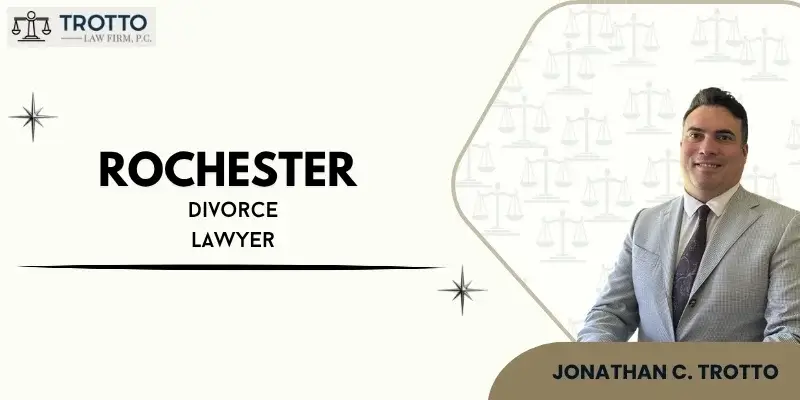
When you work with our law firm, you are represented by an attorney honored as a Super Lawyers Rising Star for twelve consecutive years, from 2014 through 2025. In or out of court, we advocate on your behalf. Our law firm offer both litigation and collaborative law services.
FAQs About Rochester, NY Divorce Law
How Much Is a Divorce Lawyer?
The circumstances of each divorce case will have an impact on the overall cost. Whether the divorce is contested or uncontested may determine the amount of time and resources that an attorney will need to invest in your case. How much your attorney costs could depend on the types of divorce cases they handle and their experience.
What Is a Wife Entitled to in a Divorce?
Like a husband, a wife is entitled to her separate property and an equitable portion of the marital property in a divorce. Regardless of gender, either spouses are entitled to certain pieces of the divorce settlement. Both spouses may receive, among others:
- Child support
- Child custody
- Spousal maintenance
- An equitable division of assets
The final divorce settlement is based not on gender but on other qualities of the spouses, such as:
- Income
- Living circumstances
- Employment
- Stability
- Mental and physical health
How Long Do You Have to Be Separated to Get a Divorce in New York?
Each divorce is unique, and the grounds of the divorce will determine the amount of time of separation that must take place prior to the final divorce settlement. In a no-fault divorce in New York, the couple must be separated for at least one full year before moving forward. That year allows the couple to attempt a reconciliation or work to agree to divorce terms without court intervention.
Can You Date While Separated During Divorce?
While the divorce process is occurring, no rule makes dating illegal. However, challenges can arise for those who choose to do so. It is important to remember that, during the process, you are still legally married to the other party. If you share children, more complications may be possible. Speak with your attorney if you are considering dating while separated.
Contact Our Rochester Divorce Lawyers Today
Divorce is a complicated process that is often filled with emotions. Navigating the process requires support from a compassionate and effective attorney who can advocate for your rights through mediation, arbitration, or litigation. Although you may have many questions about divorce, the legal team at Trotto Law Firm, P.C., has the answers. Contact our offices today and find out how we can help.
We serve clients in Rochester from our local office.
To schedule a consultation, call (585) 684-7947
Serving Rochester and Monroe County
When your family faces divorce, custody disputes, or other complex family law matters in Rochester or throughout Monroe County, you need an attorney who combines sophisticated legal expertise with genuine compassion and understanding of family values. At Trotto Law Firm, P.C., founder Jonathan C. Trotto continues a family tradition of legal service that spans generations—his father served the Rochester community for 32 years, his uncles provided legal counsel, and now Jonathan dedicates his practice to helping fellow residents navigate the most challenging times in their lives with dignity and personalized attention.
Established in 2009 and based in Rochester, Trotto Law Firm brings a unique combination of business acumen and litigation excellence to every family law case. Jonathan’s undergraduate degree in business (with a double major in Finance and Economics from St. Joseph’s University) means he truly understands the financial complexities of divorce, property division, and support matters, while his J.D. with a concentration in Litigation from Thomas M. Cooley Law School provides the courtroom skills necessary to protect your interests. As an active member of the Collaborative Law Association of the Rochester Area and the International Academy of Collaborative Professionals, Jonathan offers multiple paths to resolution—whether through collaborative law, mediation, or vigorous litigation when necessary.
Whether you’re navigating a high-net-worth divorce with complex asset division, fighting for custody of your children, seeking modification of existing orders, protecting your medical practice or business during divorce, addressing military family law issues, or pursuing any family law matter in Rochester, partnering with an attorney who has been recognized as a Rising Star by Super Lawyers for seven consecutive years and honored with the “Up & Coming Attorney” award by The Daily Record—yet who lives in Pittsford with his wife, son, dog, and cat, and genuinely understands the challenges families face—can be the difference between feeling overwhelmed by the legal process and having a trusted advocate who tailors dynamic strategies to your unique circumstances.